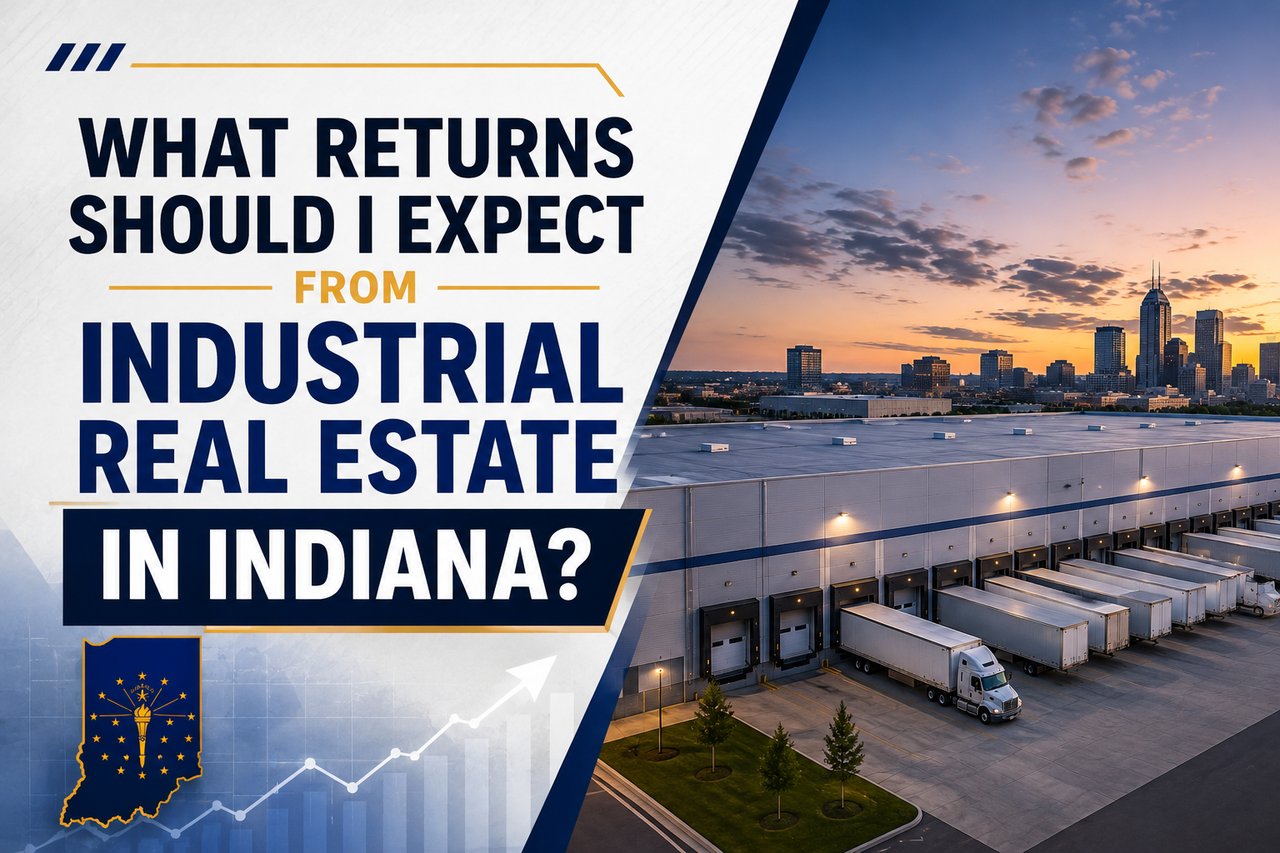
One of the most common mistakes new industrial investors make is treating a cap rate as their return. A 7% cap rate does not mean you'll earn 7% a year. To understand industrial real estate returns in Indiana, you need a few more tools — and an honest view of leverage, capital costs and exit value.
Cash-on-cash return
Cash-on-cash return measures annual cash flow after debt service divided by the cash you invested. If you put $1,000,000 into a building in Noblesville and it generates $80,000 a year after mortgage payments, your cash-on-cash return is 8%. It's a useful snapshot of current yield on your money, but it ignores appreciation and sale proceeds.
Internal rate of return (IRR)
IRR measures total return over the life of the investment, including annual cash flow and the sale, while accounting for when each dollar arrives. Money received sooner is worth more than money received later. IRR is the standard metric for comparing investments with different hold periods and cash flow patterns.
Equity multiple
Equity multiple is total cash returned divided by total cash invested. Invest $1,000,000, receive $2,000,000 back over seven years, and your equity multiple is 2.0x. It tells you how much you made, but not how fast.
Why you need all three metrics
A quick flip can produce a strong IRR with a small multiple. A long-term hold can produce a large multiple with a modest IRR. Cash-on-cash shows whether the property pays you along the way. Looking at all three gives a complete picture of industrial real estate returns.
How leverage changes industrial returns
Debt can boost returns when the property's yield exceeds the interest rate. When interest rates rise above the cap rate — known as negative leverage — borrowing can actually reduce cash-on-cash returns. In recent years, many Indiana investors have bought with lower leverage, more cash or seller financing to manage this.
Where industrial returns really come from
• Buying right: purchase price relative to income, replacement cost and market rents
• Rent growth: bringing below-market leases to market
• Occupancy: keeping buildings full and tenants renewing
• Expense control: managing operating costs and capital projects
• Exit timing: selling when demand and pricing are strong
An example of industrial returns in Indiana
An investor buys a small multi-tenant industrial building in Indianapolis with modest leverage. Year-one cash-on-cash return is moderate because a few tenants pay below-market rents. Over five years, the investor renews leases closer to market, replaces lighting and repaves the lot, and keeps occupancy high. Net operating income rises, and when the building sells, the gain from higher income drives most of the total return. The cap rate at purchase told only a small part of the story.
Active vs. passive industrial returns
Operators who manage leasing and asset management directly often target higher returns in exchange for more work and risk. Passive investors in syndications or funds accept lower control in exchange for convenience. Know which role you want before you invest.
Risks that reduce returns
• Unexpected vacancy and re-leasing costs
• Major capital repairs
• Rising interest rates at refinance
• Higher exit cap rates when selling
• Tenant defaults
Setting realistic return targets for Indiana industrial
Return targets should match the risk of the property. A stabilized building with a long lease to a strong tenant warrants a lower target than a half-vacant multi-tenant building that needs a new roof. When investors apply the same target to every deal, they either overpay for risky properties or pass on solid, lower-risk ones.
I encourage clients to set three numbers before they look at deals: a minimum cash-on-cash return they need for current income, a target IRR for the full hold, and the maximum leverage they're comfortable carrying. Those guardrails make it much easier to evaluate opportunities quickly and avoid emotional decisions. Strong industrial real estate returns in Indiana come from discipline on the way in, not optimism on the way out.
Frequently asked questions
What is a good IRR for industrial real estate? It depends on risk; stabilized assets warrant lower targets than value-add deals.
Is cash-on-cash return the same as cap rate? No. Cash-on-cash includes debt; cap rate does not.
What is negative leverage? When borrowing costs exceed the property's yield, reducing equity returns.
Model industrial real estate returns with Annie Scott
I build clear, conservative return analyses for Indiana industrial buyers so every deal is judged on its full picture — not a single number.
Annie Scott — Annie Scott Realty Group LLC / F.C. Tucker Company Cell: (317) 902-8622 ·