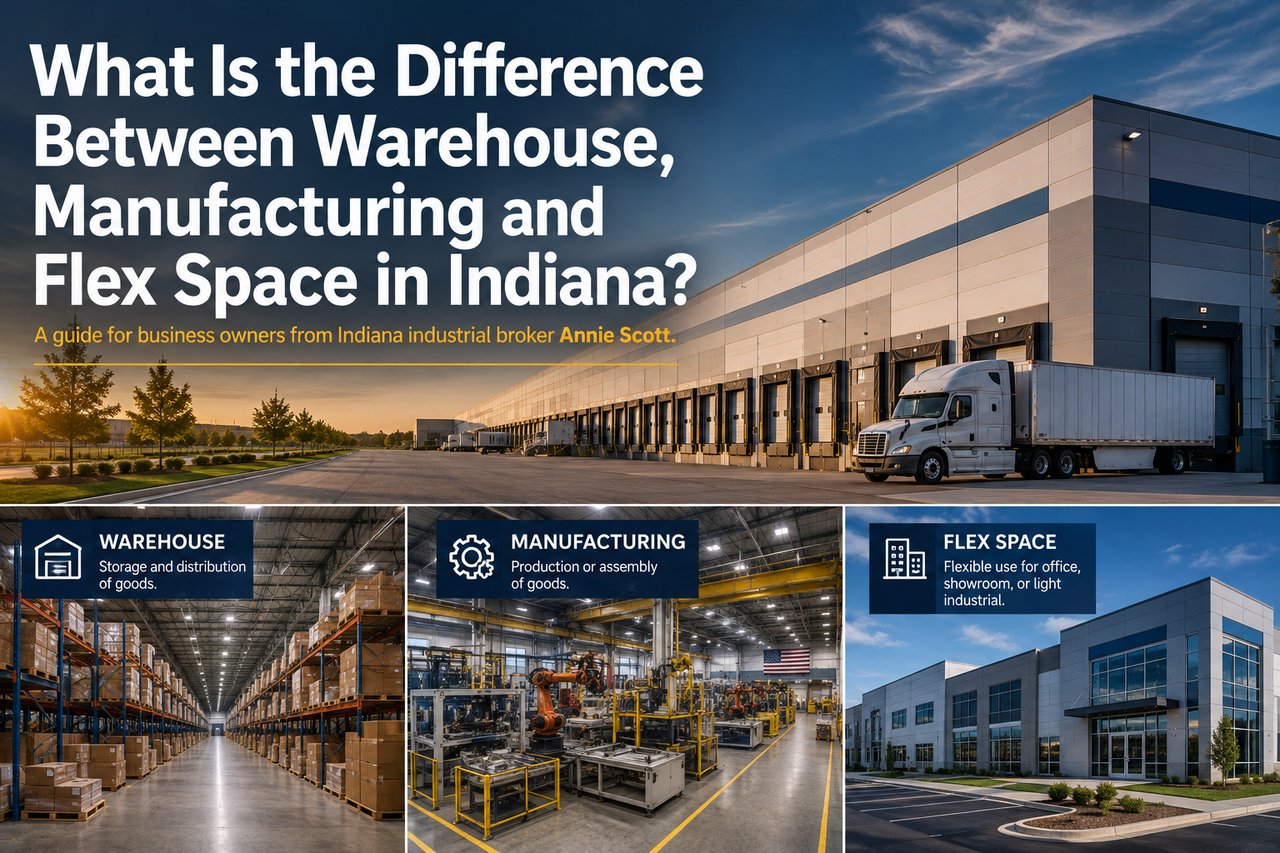
One of the first questions I ask any business owner searching for industrial space in Indiana is simple: what happens inside the building? The answer usually points to one of three property types — warehouse, manufacturing or flex space. Each has different rents, lease terms, building specs and risks. Choosing the right type of industrial property in Indiana can save your business real money and years of frustration.
Warehouse and distribution space in Indiana
Warehouse and distribution buildings store and move goods. In Central Indiana, the largest examples line I-70 in Plainfield, I-65 in Whitestown and Greenwood, and I-70 east near Mt. Comfort. Their value comes from:
• Clear height — modern bulk warehouses often offer 32 to 40 feet
• Dock-high loading doors with levelers and seals
• Deep truck courts and trailer parking
• ESFR sprinklers for high-piled storage
• Quick interstate access
Warehouse tenants include e-commerce fulfillment operations, third-party logistics (3PL) providers, wholesalers and national retailers. Smaller warehouse space — 10,000 to 50,000 square feet — serves local distributors across Indianapolis, Noblesville, Greenwood and Anderson.
Manufacturing buildings in Indiana
Indiana has one of the highest shares of manufacturing employment in the country, so manufacturing buildings are everywhere: Indianapolis's established industrial corridors, Anderson, Kokomo, Lafayette, Shelbyville, Franklin and beyond. Manufacturing space needs:
• Heavy electrical power, often three-phase 480-volt service with substantial amperage
• Strong floors for heavy machinery
• Crane capacity in some cases
• Zoning that permits industrial processes
• Water, gas and ventilation for specific operations
Manufacturing buildings are often specialized. That makes them harder to re-lease if a tenant leaves, but very "sticky" for the right user. A manufacturer that has invested millions in equipment and electrical upgrades rarely moves without a strong reason.
Flex space in Indianapolis, Carmel and Fishers
Flex space blends office or showroom space with warehouse or shop space. Flex buildings typically offer 14 to 24 feet of clear height, grade-level drive-in doors, more glass at the front and a higher office percentage than a warehouse.
Flex space in Indianapolis's northern suburbs — Carmel, Fishers, Westfield, Noblesville and Zionsville — is especially popular with:
• Contractors and trades businesses
• Medical device and health technology firms
• Engineering and tech companies with light assembly
• Showroom businesses such as flooring, cabinets and lighting
• E-commerce startups
Flex space offers a professional front for customers and a working back for operations, which is why it's often in short supply in Hamilton County.
A fourth option: industrial outdoor storage
Some businesses need land more than buildings. Industrial outdoor storage (IOS) sites provide fenced, lit yards for trucks, trailers, equipment or materials, often with a small shop or office. Trucking companies, equipment dealers and contractors around Indianapolis's interstates increasingly seek IOS.
Warehouse vs. flex space in Indiana: how costs compare
In general:
• Flex space carries higher rents per square foot because of more office finish, glass and parking.
• Warehouse space has lower rents per square foot, especially in larger buildings.
• Manufacturing space varies widely depending on power, cranes and specialized improvements.
But rent per square foot isn't the whole story. A 20,000-square-foot warehouse with 32-foot clear height may store more product than a 30,000-square-foot building with 18-foot ceilings. The right comparison is cost per unit of usable capacity.
How lease terms differ by industrial property type
Flex tenants often sign three- to five-year leases and move as they grow. Warehouse leases commonly run five to ten years. Manufacturing leases can run ten years or longer because of the investment involved. Investors price these differences into cap rates and values.
Which type of industrial property is right for your Indiana business?
Ask three questions: Do customers visit you? Do you produce goods or store them? How tall and heavy is what you handle? Customer-facing businesses lean toward flex. Producers need manufacturing space. Storage and shipping operations need warehouses. Many businesses fall between categories, which is where local market knowledge makes the difference.
Frequently asked questions
Is flex space more expensive than warehouse space in Indiana? Usually yes per square foot, because flex includes more office finish and parking.
Can I run light manufacturing in flex space? Often, if zoning, power and the lease permit it.
Where is most flex space in the Indianapolis area? Hamilton County, the north side of Indianapolis and established business parks around the metro.
What clear height do I need for warehouse space? Local distributors often need 24 to 30 feet; regional distributors usually want 32 feet or more.
Find the right industrial property in Indiana
I help Indiana businesses match their operations to the right property type — warehouse, manufacturing, flex or outdoor storage — and negotiate terms that support growth.
Annie Scott — Annie Scott Realty Group LLC / F.C. Tucker Company Cell: (317) 902-8622 ·