Brokers and investors in Indianapolis constantly describe warehouses as "Class A" or "Class B." There' s no official grading system, but the labels carry real meaning for rent, value and tenant demand. Understanding the difference between Class A, B and C industrial buildings in Indianapolis helps tenants find better value and helps investors buy smarter.
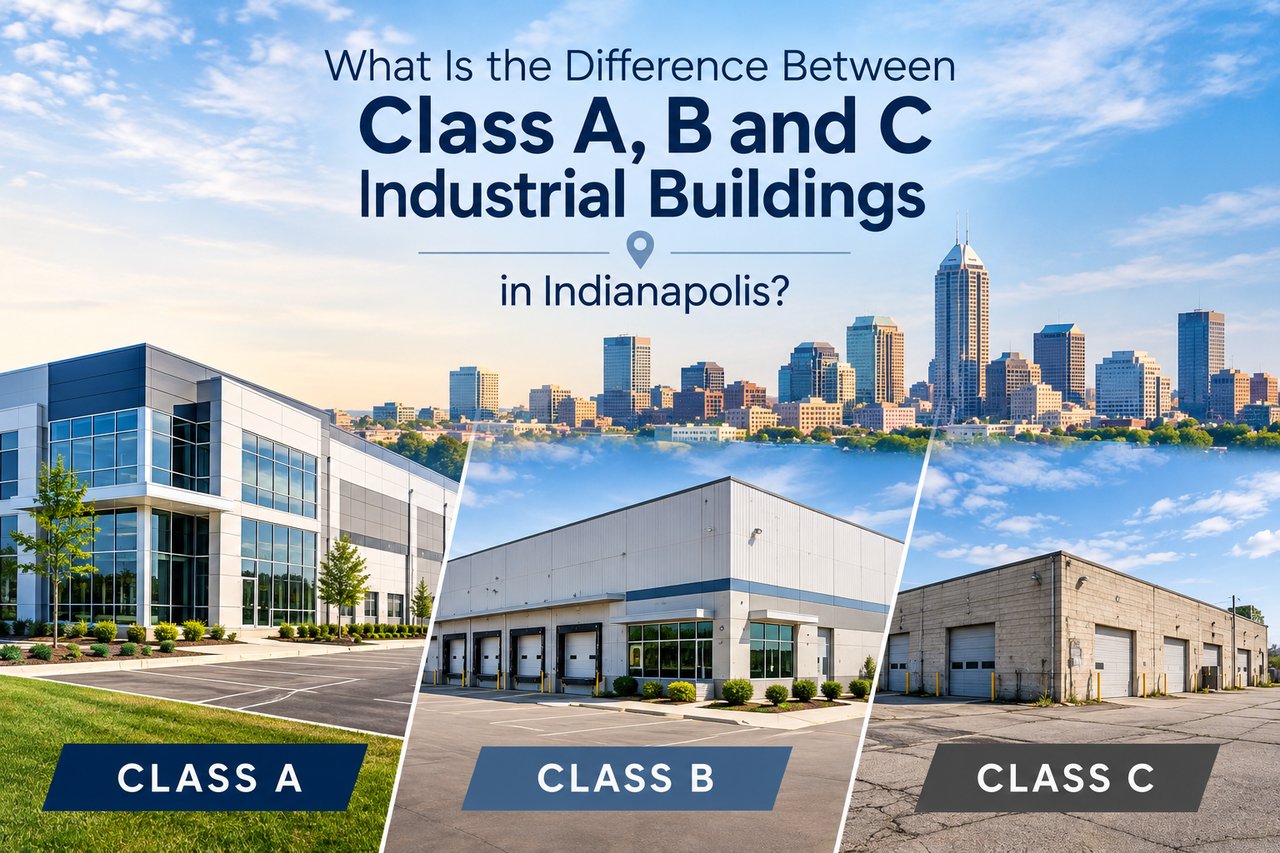
Class A industrial buildings in Indianapolis
Class A industrial buildings are newer — typically built within the last 10 to 15 years — and designed for modern logistics. In Plainfield, Whitestown, Lebanon, Greenwood and Mt. Comfort, Class A buildings usually feature:
• 32- to 40-foot clear heights
• ESFR sprinkler systems
• Wide column spacing
• Many dock-high doors with levelers
• Deep truck courts and trailer parking
• Ample car parking and LED lighting
Class A buildings attract national retailers, 3PLs and institutional investors. They command the highest rents and lowest cap rates.
Class B industrial buildings in Indianapolis
Class B industrial buildings are older or smaller but still functional. Think of a 1990s warehouse with 24- foot clear height, a solid roof and adequate loading, or a multi-tenant small-bay building in Indianapolis, Noblesville or Greenwood. Class B is where many of Central Indiana's local manufacturers, distributors and contractors operate.
Class C industrial buildings in Indianapolis
Class C buildings are older and less efficient: low ceilings, few loading doors, outdated electrical systems, deferred maintenance or awkward layouts. Many sit in Indianapolis's older industrial corridors. They still serve users with modest needs and can offer redevelopment or outdoor storage potential.
Why Class B industrial in Indianapolis often outperforms
This is one of the most important insights for anyone in the Indianapolis industrial market. Construction costs have risen sharply over the past several years, so new buildings need much higher rents to make financial sense. That creates a large gap between what a new building must charge and what a well- maintained Class B building charges.
At the same time, developers rarely build Class B-style or small-bay product today because the economics don't work. Limited new supply plus strong demand from local businesses means Class B industrial in Indianapolis often stays well occupied, with steady rent growth.
How tenants should choose between Class A and Class B
Ask what your operation really needs:
• Do you need to stack 35 feet high, or would 22 feet work?
• Do you load dozens of trucks a day, or a few?
• Do you need modern sprinklers for high-piled storage?
• How important are image and employee amenities?
A national distributor may need Class A. A growing contractor or local manufacturer may save significantly with a clean, well-located Class B building.
How investors can add value to Class B and C industrial buildings
Investors often target Class B and C industrial buildings in Indianapolis because they trade at higher cap rates and offer upside. Common value-add improvements include:
• Roof replacement and new insulation
• LED lighting
• New dock levelers and overhead doors
• Paving and striping
• Fresh paint and updated offices
• Adding loading doors or demising into smaller units
These improvements can justify higher rents and lower vacancy.
Building class and lease terms
Class A tenants often sign longer leases with larger companies. Class B tenants are frequently local businesses that sign three- to five-year leases. That means more turnover — but also more frequent chances to bring rents to market.
A real-world comparison: Class A vs. Class B industrial in Indianapolis
Consider a growing HVAC distributor that needs about 40,000 square feet. Option one is a section of a new Class A building in Plainfield with 36-foot clear height, ESFR sprinklers and dozens of dock doors. Option two is a well-maintained 1990s Class B building on the west side of Indianapolis with 24-foot clear height, six dock doors and two drive-in doors.
The distributor stacks product about 18 feet high, loads a handful of trucks per day and runs a fleet of vans. The Class A building offers features it will never use, at a higher rent and with a larger share of the operating expenses. The Class B building fits the operation, sits closer to its customers and saves meaningfully on total occupancy cost every year of the lease. For this tenant, Class B industrial in Indianapolis is the smarter choice.
Flip the scenario — a regional e-commerce brand stacking 30 feet high and shipping hundreds of orders a day — and Class A becomes the only realistic option. The right building class always depends on the operation.
What's next for Class B industrial in Indianapolis
With construction costs still elevated and little new small or mid-sized product being built, I expect well- located Class B industrial in Indianapolis to stay in demand. The buildings that will struggle are those with real functional problems — very low ceilings, poor truck access or failing roofs — that owners don't address. Owners who invest in practical upgrades should continue to outperform.
Frequently asked questions
What clear height makes a building Class A in Indianapolis? Most modern Class A distribution buildings offer 32 feet or more.
Is Class B industrial a good investment in Indianapolis? It can be, thanks to limited new supply and strong local demand, but buyers must budget for capital needs.
Are Class C buildings worth buying? Sometimes, especially when priced near land value or suited to outdoor storage or redevelopment.
Compare Class A and Class B industrial space in Indianapolis
I help tenants and investors compare Class A, B and C industrial buildings in Indianapolis so they pay for the features they need — and nothing they don't.
Annie Scott — Annie Scott Realty Group LLC / F.C. Tucker Company Cell: (317) 902-8622 ·