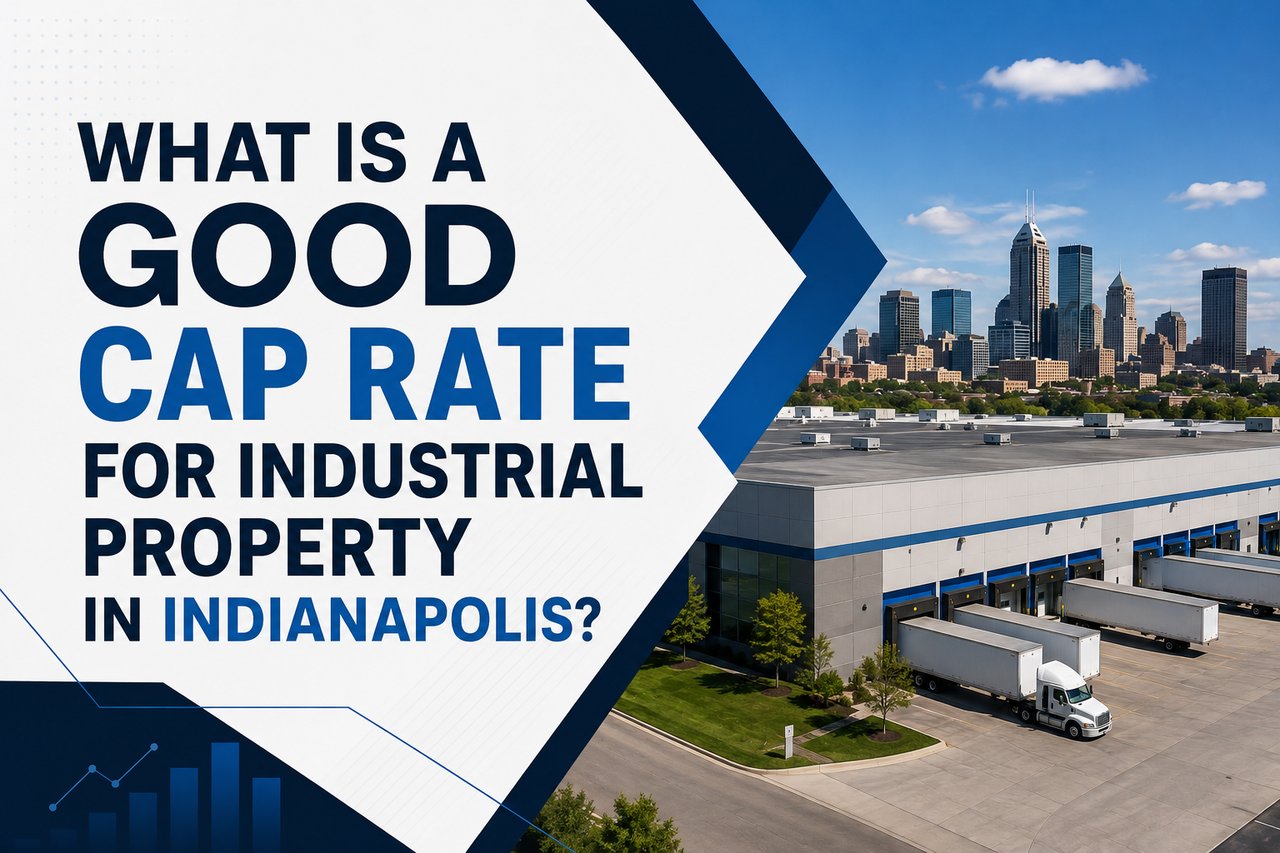
"What" a good cap rate?" is one of the first questions investors ask me about industrial property in Indianapolis. It's also one of the most misunderstood numbers in commercial real estate. Ask a dozen seasoned professionals to define and calculate a cap rate precisely and you may get a dozen slightly different answers. This guide explains how industrial cap rates in Indianapolis work, what makes one "good," and how to use them without being misled.
How to calculate a cap rate
The capitalization rate is net operating income divided by purchase price: Cap rate = Net Operating Income (NOI) ÷ Price If a warehouse in Greenwood produces $200,000 a year in NOI and sells for $3,000,000, the cap rate is 6.67%. Flip the formula and you get value: NOI divided by cap rate equals price.
What counts as NOI on an industrial property
NOI is income after operating expenses but before mortgage payments, depreciation and income taxes. In a true triple-net lease, NOI is close to base rent because tenants reimburse taxes, insurance and maintenance. But owners still face costs: vacancy, non-recoverable expenses, management and reserves for roofs and parking lots. Whether those items are deducted changes the cap rate.
Why two brokers can quote different cap rates on the same building
Sellers sometimes quote cap rates on projected rent instead of in-place rent. Some deduct reserves; others don't. Some use trailing 12 months, others next year's income. When you see a cap rate on an Indianapolis industrial listing, always ask: whose NOI, which year, and what was deducted?
What drives industrial cap rates in Indianapolis
• Building quality: modern Class A distribution buildings trade at lower cap rates than older Class B and C buildings.
• Location: properties near I-465 and major interstates or in supply-constrained suburbs command lower cap rates.
• Tenant credit: a national, creditworthy tenant lowers perceived risk.
• Lease term: longer remaining terms reduce risk and cap rates.
• Rent vs. market: below-market rents with near-term rollover can justify paying a lower going-in cap rate.
• Interest rates: higher borrowing costs generally push cap rates up.
• Property size and buyer pool: smaller properties attract local buyers and often trade at higher cap rates.
So what is a "good" cap rate for industrial property in Indianapolis?
There's no single right answer. A "good" cap rate is one that properly compensates you for the risk you're taking. A lower cap rate on a modern building leased long-term to a strong tenant in Plainfield may be a better investment than a higher cap rate on an older building in a weak location with a lease expiring next year. The right comparison is against similar properties in similar locations with similar risk.
What cap rates don't tell you
A cap rate is a snapshot of year-one income. It ignores future rent growth, lease expirations, capital needs, financing and the eventual sale. Two buildings with identical cap rates can produce very different returns. That's why I always pair cap rates with cash-on-cash return, internal rate of return and a realistic capital plan.
An example: same cap rate, different investments
Two 30,000-square-foot buildings in Central Indiana are offered at the same cap rate. Building A has a tenant paying below-market rent with two years left and a roof replaced last year. Building B has a tenant paying above-market rent with eight years left and a 25-year-old roof. Building A offers rent upside and fewer capital needs; Building B offers income stability but rent risk at renewal and a looming roof replacement. Same cap rate, completely different risk profiles.
How to use cap rates wisely
1. Confirm exactly how the seller calculated NOI
2. Recalculate using your own expense and reserve assumptions
3. Compare in-place rent to market rent
4. Review lease expirations and tenant credit
5. Price capital needs into your offer
6. Compare against recent sales of similar buildings in the same submarket
Frequently asked questions about industrial cap rates in Indianapolis
Is a higher cap rate better? It means more income per dollar invested, but usually reflects higher risk.
Do cap rates include mortgage payments? No. Cap rates are calculated before debt service.
Why are cap rates lower for new warehouses? Buyers see less risk and stronger long-term demand for modern buildings.
How do I find current industrial cap rates in Indianapolis? Recent comparable sales and broker market data are the best sources.
Analyze Indianapolis industrial deals with Annie Scott
I underwrite industrial properties across Central Indiana and help investors look past the headline cap rate to the real risk and return.
Annie Scott — Annie Scott Realty Group LLC / F.C. Tucker Company Cell: (317) 902-8622 ·