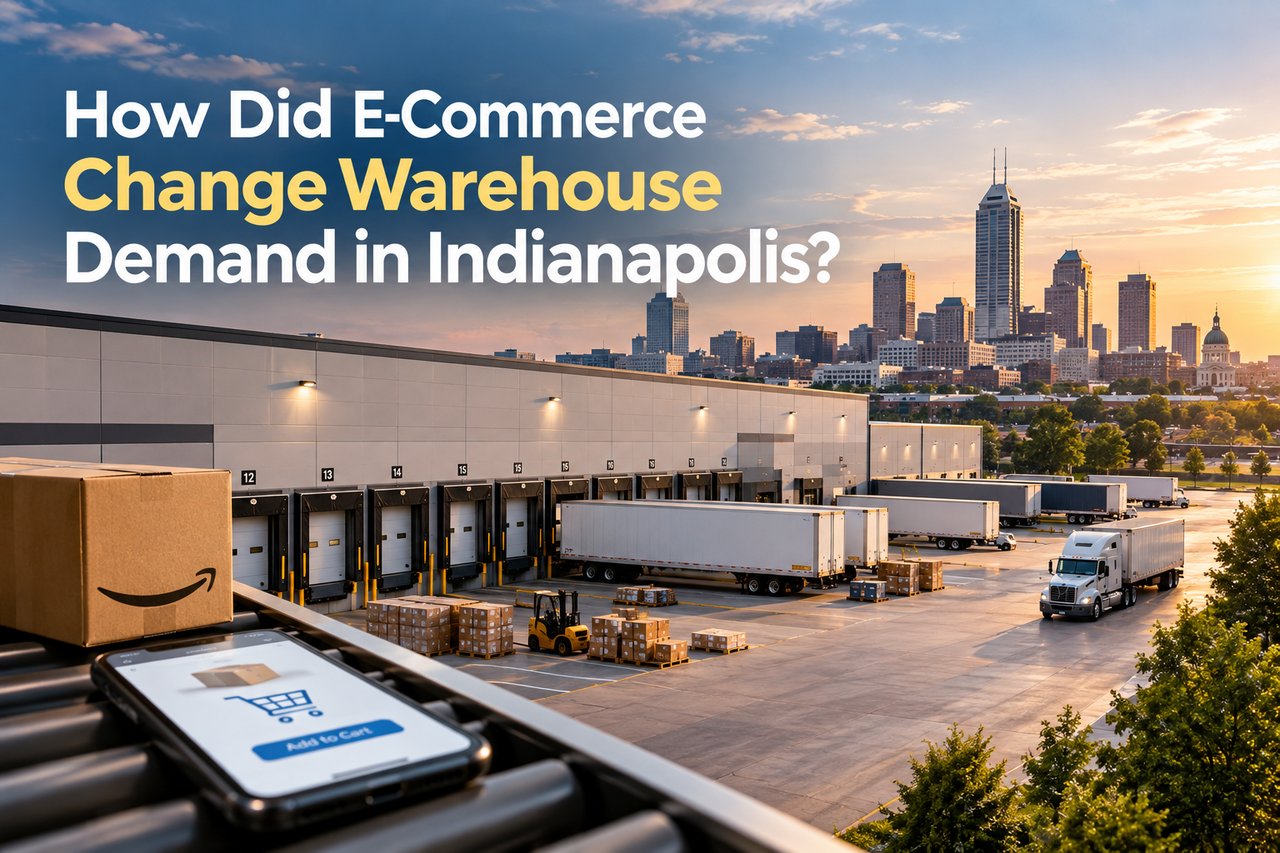
Every time someone clicks "buy now" a warehouse somewhere has to receive, store, pick, pack and ship that order. Multiply that by billions of orders a year and you understand why e-commerce warehouse demand in Indianapolis exploded over the last decade. Online retail of didn't just add more warehouses to Central Indiana — it changed what those warehouses look like, where they're built and how much tenants pay for them.
Why e-commerce needs more warehouse space than traditional retail
A traditional store holds inventory on its shelves, and customers do the picking. An online retailer has to hold a wider range of products in a warehouse, pick each order individually, pack it, ship it and then process returns. Industry studies have long suggested e-commerce requires substantially more warehouse space per dollar of sales than store-based retail. That extra space translated directly into demand for e-commerce warehouse space in Indianapolis.
Why Indianapolis became an e-commerce warehouse hub
Central Indiana checks every box an online retailer needs:
• Reach: four interstates meet at I-465, putting a large share of U.S. households within a day's drive.
• Air cargo: the FedEx hub at Indianapolis International Airport supports fast parcel shipping.
• Workforce: a deep pool of logistics and warehouse workers across Marion, Hendricks, Johnson, Boone and Hancock counties.
• Land: large, flat sites in Plainfield, Whitestown, Greenwood, Mt. Comfort and Lebanon.
• Costs: competitive rents, Indiana's 3% property tax cap on commercial and industrial property, and local incentives.
The result was a wave of large fulfillment centers and distribution buildings across the metro.
How e-commerce changed warehouse design in Central Indiana
E-commerce warehouses in Indianapolis look different from the warehouses of 20 years ago:
• Taller buildings: 32- to 40-foot clear heights support high racking and multi-level pick modules.
• More parking: fulfillment centers employ hundreds of workers per shift and need large car lots.
• More trailer storage: trailers stage in the yard waiting to load or unload.
• More power: conveyors, sortation and robotics need electrical capacity.
• Better lighting and climate control: to support worker comfort and productivity.
Older buildings without these features still serve many users, but they compete for a different set of tenants.
The rise of last-mile warehouses near Carmel, Fishers and Indianapolis
Fast delivery requires facilities close to customers. Last-mile warehouses are smaller buildings near population centers that handle the final leg of delivery. In Central Indiana, that drives demand for smaller distribution and flex buildings in Hamilton County, the north side of Indianapolis, Greenwood and inner-ring neighborhoods. Because land is scarce and expensive in those areas, well-located older buildings have become surprisingly valuable.
What happened after the pandemic e-commerce surge
During the pandemic, online sales spiked and many retailers leased aggressively. Some later found they had overexpanded and put space back on the market through subleases. That created temporary softness in parts of the big-box segment. But the long-term direction hasn't changed: online shopping continues to take a larger share of retail sales, and retailers keep investing in faster delivery networks.
What e-commerce warehouse demand means for Indianapolis tenants
If you're a local distributor, e-commerce competition can raise rents in the most popular corridors and make modern space harder to find. The flip side is opportunity: when large users consolidate, sublease space can become available at a discount, and older buildings that don't fit national retailers can be excellent value for local companies.
What it means for Indianapolis industrial owners and investors
E-commerce has created one of the deepest tenant pools in industrial real estate. Owners of well- located buildings with good clear height, loading and parking can lease faster and push rents. Owners of functionally obsolete buildings may need to invest in upgrades or target different users.
Frequently asked questions
Why are there so many fulfillment centers around Indianapolis? Central location, interstate access, air cargo, workforce and land availability.
What is a last-mile warehouse? A smaller facility near customers that handles final delivery, often in suburbs like Carmel, Fishers and Greenwood.
Is e-commerce warehouse demand in Indianapolis still growing? Online sales continue to gain share, which supports long-term demand even when short-term leasing slows.
Can a small business find e-commerce warehouse space in Indianapolis? Yes. Small-bay and flex buildings work well for many online sellers.
Find e-commerce warehouse space in Indianapolis
Whether you' re launching an online brand from a 5,000-square-foot flex unit or planning a regional fulfillment center, I help e-commerce companies find the right warehouse space in Indianapolis and across Central Indiana.
Annie Scott — Annie Scott Realty Group LLC / F.C. Tucker Company Cell: (317) 902-8622 ·